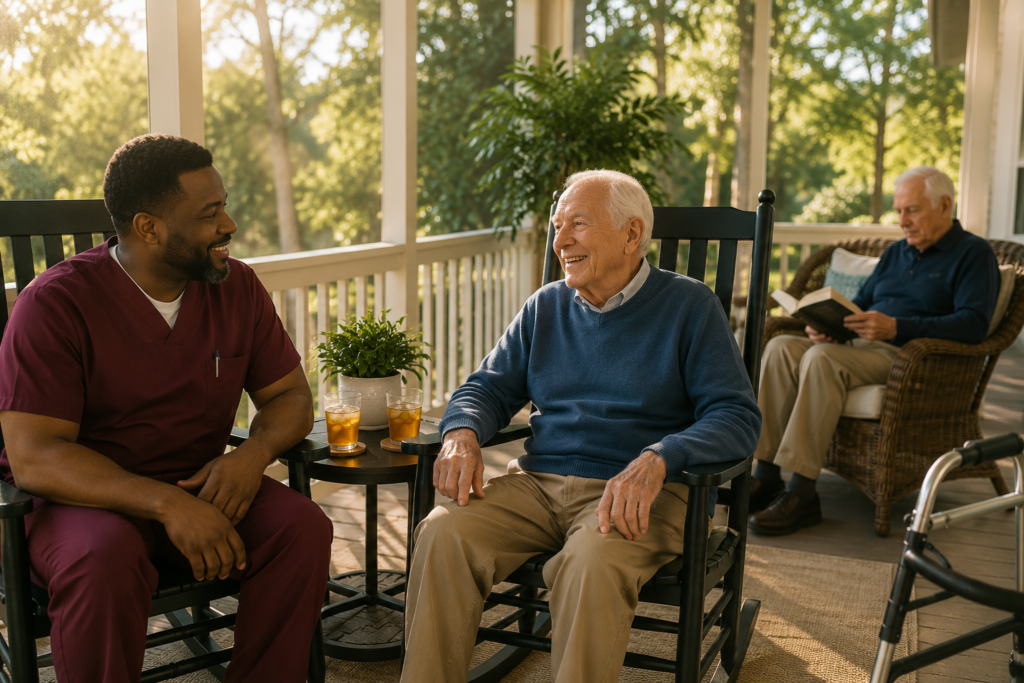
Socialization in Memory Care: Why More People Doesn’t Always Mean More Connection
By The Sanctuary
Posted August 24, 2026
One of the most common concerns families raise with me when they are considering a smaller residential setting is socialization in memory care. They ask some version of: “If Mom moves into a home with only a handful of residents, will she have enough people to socialize with?”
It is a thoughtful question, and I completely understand the instinct behind it. When most of us picture socialization, we imagine a room full of people talking, laughing, playing games, or eating together. So it seems logical that a community with 50 or 100 residents would create more opportunities for friendship than a home with six.
But after years of working exclusively with people living with dementia, I have come to believe that headcount is the wrong way to measure connection.
The better question is: “Who will my loved one actually spend meaningful time with every day?”
That distinction matters because meaningful socialization in memory care is not simply about having other people nearby. It is about being known, included, engaged, and connected in ways that still make sense to the individual person.
Why Socialization in Memory Care Looks Different
Dementia affects people very differently. Two residents can have the same diagnosis and be living in completely different worlds.
· One person may remain extremely social but forget what was said five minutes ago.
· Another may have wonderful long-term memories but struggle to find words because of aphasia.
· Someone may still carry on a long conversation but need significant physical assistance.
· Another person may be physically active while living with much more advanced cognitive impairment.
Because of those differences, it is actually uncommon to find a large group of residents who are all at the same cognitive, verbal, emotional, and physical level at the same time. That does not mean friendships between residents do not happen. They absolutely do, and some are wonderful to watch develop.
But families sometimes assume that putting more residents in one building automatically creates more meaningful conversation. In my experience, it does not. A person can be surrounded by dozens of people and still have very little genuine interaction.
That is consistent with a broader distinction researchers make between social isolation and loneliness: simply being around other people is not the same thing as feeling connected. For a person living with dementia, the quality, familiarity, and accessibility of an interaction can matter enormously.
The Richest Conversations Often Happen Between Activities
One of the things that surprises families when they spend time in our homes is where the richest interactions happen.
They are not always during a scheduled music program, exercise class, or craft. Often they happen in the kitchen while dinner is being prepared, at the breakfast table over coffee, on the porch, or while someone is folding towels beside a caregiver.
Maybe a resident is helping peel vegetables. Maybe she is sitting at the counter while a caregiver cooks. Maybe they are talking about her grandchildren because the caregiver knows every one of their names.
Those moments are not on an activity calendar. They happen because two people know one another well enough for conversation to emerge naturally.
This is one reason continuity of caregivers matters so much. When the same people care for someone over time, they accumulate the small details that make connection possible.
· They know who likes two sugars in her coffee.
· They know who grew tomatoes every summer.
· They know who spent 40 years teaching elementary school.
· They know which football team someone has cheered for since childhood.
· They know which stories make someone laugh and which subjects make her anxious.
Those details become conversation starters. More importantly, they tell the resident—often without anyone needing to say it directly—“I know you.”
Meaningful Engagement Is More Than an Activity Calendar
Activity calendars matter. Music, exercise, art, games, outings, animals, and other programs can bring enormous joy and stimulation. We use them too.
But I would never choose a dementia care community based on the calendar alone.
The National Institute on Aging recommends helping people with Alzheimer’s remain involved in activities they enjoy and specifically includes ordinary daily experiences such as cooking, gardening, walking, music, household chores, pets, and visiting with others. That is important because meaningful engagement does not have to look like a formal group activity.
In fact, for many people with dementia, ordinary life can be more accessible than a highly structured program. Setting the table may feel familiar. Watering flowers may evoke years spent gardening. Listening to a caregiver cook while chatting at the kitchen counter may be easier to participate in than following a group discussion in a crowded room.
The goal should not be to keep someone busy every minute. The goal is to create frequent opportunities for connection, purpose, enjoyment, and belonging throughout the day.
More Residents Can Sometimes Mean More Stimulation, Not More Connection
There is another side to this that families do not always consider: more people also means more noise, more movement, more conversations happening at once, and more stimulation to process.
For some people living with dementia, that is energizing. For others, it can be overwhelming.
A person who once loved a busy restaurant may eventually struggle to follow a conversation when multiple voices are competing for attention. Someone who was once extremely outgoing may begin withdrawing in larger groups because processing language and environmental stimulation has become harder.
This is why I do not think there is a universal rule that smaller is always better or larger is always better. The real question is whether the environment creates interactions that the particular person can actually access and enjoy.
How We Think About Socialization at The Sanctuary
At The Sanctuary, we operate small residential homes, so naturally families ask whether six residents is enough. My answer is that I do not think six—or 60—is the right metric.
I care much more about what happens during the ordinary hours of the day.
Does someone sit beside a resident at breakfast and talk to her? Does a caregiver know enough about a resident’s life to start a conversation she can participate in? Does someone notice when a normally talkative resident is unusually quiet? Is a resident invited to help in the kitchen because she spent her life cooking for her family? Does somebody sit down, or are staff members always passing through on the way to the next task?
Over time, the circle expands beyond residents and caregivers. Family members who visit frequently begin to know the other residents. Musicians return and learn favorite songs. Therapy dog volunteers recognize familiar faces. Nurses, therapists, and other regular visitors become part of the rhythm of the home.
The result is a kind of social environment that is difficult to quantify. It feels less like assembling a large group of people in the same place and more like a small neighborhood in which people become familiar to one another.
For someone living with dementia, familiarity itself can be deeply valuable. A resident may not remember every conversation or even every name, but she can still experience warmth, comfort, humor, recognition, and the feeling that the people around her are safe.
What Families Should Look for on a Memory Care Tour
If socialization is important to you—and it should be—I would absolutely ask about activities. But I would also spend time observing what happens when no activity is scheduled.
Look for things like:
· Do caregivers and residents talk naturally when they are not completing a care task?
· Do caregivers appear to know residents’ histories, preferences, families, and routines?
· Are residents invited into ordinary household life, or are they mostly waiting for the next scheduled program?
· Do interactions feel individualized, or does everyone receive the same approach?
· Are residents comfortable approaching caregivers?
· Does the environment allow quieter residents to participate without being overwhelmed?
· When a resident speaks, does the caregiver stop and listen?
And then I would ask yourself one question that I think reveals more than almost anything on the activity calendar:
“If there weren’t a single scheduled activity today, would my loved one still have people who would genuinely spend time with them?”
In my experience, that answer tells you a great deal about what daily life will actually feel like.
Socialization Should Be Personal
There is also no single correct amount or type of socialization for a person with dementia.
Some residents love being in the middle of everything. Others prefer one-on-one conversation. Some enjoy participating in an activity; others are perfectly content watching from a comfortable chair. Someone who was introverted throughout her life should not suddenly be expected to enjoy constant group programming simply because she moved into memory care.
Good dementia care pays attention to who the person has always been.
That means offering connection without forcing it, creating opportunities without turning every moment into programming, and recognizing that sitting quietly beside someone can sometimes be just as meaningful as leading a group activity.
Key Takeaways
· More residents do not automatically create more meaningful socialization in memory care.
· Dementia affects communication, cognition, personality, and physical ability differently, so resident-to-resident friendships cannot be measured by headcount alone.
· Everyday interactions with familiar caregivers can be an important source of companionship and meaningful engagement.
· Formal activities matter, but ordinary moments—coffee, cooking, walking, music, gardening, conversation—matter too.
· When touring memory care, observe what happens between scheduled activities and whether residents appear genuinely known by the people caring for them.
Frequently Asked Questions
Is a small memory care home socially isolating?
Not necessarily. The number of residents alone does not determine whether someone is socially connected. Look at the frequency and quality of interactions with caregivers, other residents, family members, and regular visitors, as well as opportunities for meaningful activities throughout the day.
Do people with dementia still form friendships?
Yes. People living with dementia can absolutely enjoy friendships, companionship, affection, humor, and a sense of belonging. Dementia may change how relationships are expressed or remembered, but it does not eliminate the human need for connection.
Are group activities important for people with dementia?
They can be very valuable, particularly when they match the person’s interests and abilities. But group programming is only one form of engagement. One-on-one conversation, music, walking, cooking, gardening, household tasks, and quiet companionship can also be meaningful.
How can I tell whether a memory care community provides enough socialization?
Visit when possible and watch ordinary interactions. Notice whether caregivers know residents personally, whether conversation happens naturally, and whether residents are engaged outside scheduled programming. Ask how the community supports residents who do not enjoy large groups.
Is a larger memory care community better for a very social person?
Sometimes, but not automatically. A larger community may offer more people and programs, while a smaller setting may provide more frequent one-on-one interaction and familiarity. The best fit depends on how the individual communicates, what environments they enjoy, and what kind of interaction remains meaningful to them.
You May Also Find These Helpful
10 Questions to Ask While Touring a Memory Care Facility
Don’t leave a tour with unanswered questions. These 10 questions help you look beyond the building and activity calendar to understand what daily life will really be like for your loved one.
Helping New Residents with Dementia Adjust to Their New Home
A difficult transition does not have to become a traumatic one. Learn practical ways families and caregivers can help a loved one with dementia feel safe, comfortable, and increasingly at home.
You Can’t Optimize for Everything When Choosing Dementia Care
There is no perfect memory care community. The families who feel most at peace are often the ones who learn how to prioritize what matters most for the person they love.
Have Questions About Your Loved One?
Choosing dementia care is deeply personal, and socialization is only one part of the decision. If you are trying to understand what kind of environment would best fit your loved one’s personality, abilities, and needs, we are always happy to answer questions or show you what daily life looks like inside one of our homes.

What Should a Memory Care Assessment Really Evaluate?
A memory care assessment should reveal more than physical ability. Learn what families and communities should evaluate before a dementia-care move.

The Reality of Dementia Home Care: When Staying Home Stops Working
Dementia home care can work well—until safety, staffing, engagement or caregiver strain make the arrangement unsustainable. Learn what to watch for.

Helping a Loved One With Dementia Adjust to a New Home
A dementia care transition takes time. Learn how familiar routines, visits, consistent caregivers and thoughtful preparation can help a loved one adjust.