The First 72 Hours: What Really Happens After a Loved One Moves Into Memory Care
By The Sanctuary
Posted September 3, 2026
A daughter recently asked me a question I hear from families all the time: “Even if I know moving Mom is the right decision, what if she gets there and hates it?”
I understand that fear. In fact, I think the anticipation of a move into dementia care is often harder on the family than the transition ultimately is on the resident.
Families picture Mom sitting alone in an unfamiliar bedroom, thinking about everything she has lost. They imagine her asking to go home over and over. They picture days—or weeks—of homesickness, confusion, and distress.
And yes, the first 72 hours after a move into memory care can be emotional. A new environment is still a new environment. Some residents ask to go home. Some are confused. Some need more reassurance than usual.
But what families imagine beforehand is often very different from what those first days actually look like.
The First 72 Hours in Memory Care Aren’t Spent Sitting Alone
This is probably the biggest thing I wish families understood about the transition.
Your loved one isn’t simply sitting in a bedroom contemplating the fact that she’s homesick.
Life is happening around her.
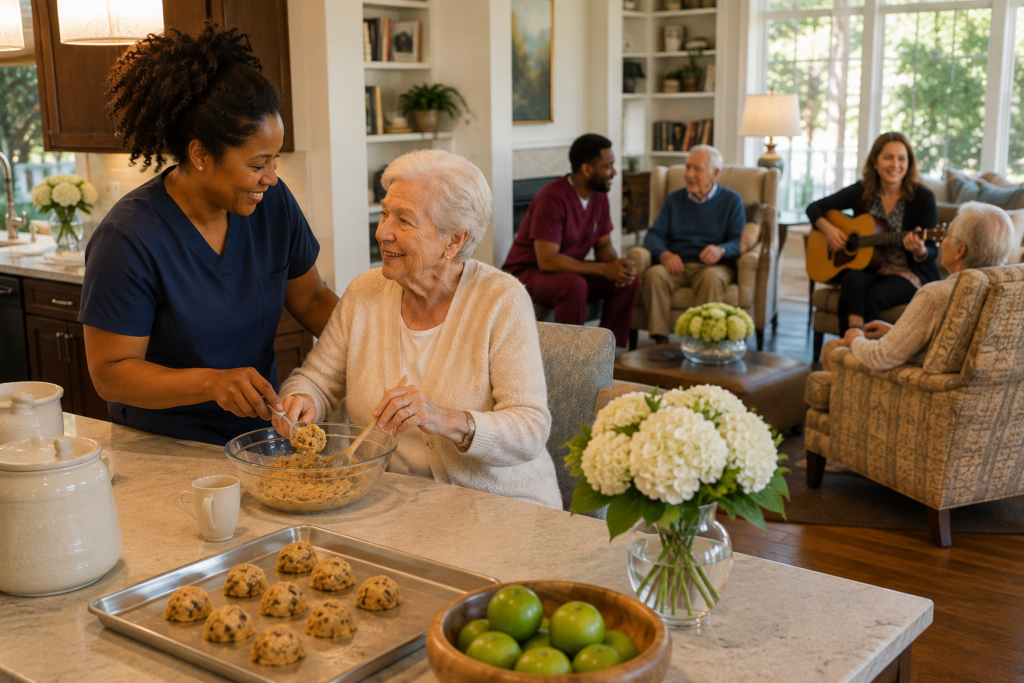
Someone is making breakfast in the kitchen. A caregiver is asking how she takes her coffee. Another resident is sitting nearby. Someone suggests going outside because the weather is beautiful. A family member visiting another resident stops to say hello.
Maybe the musician comes that afternoon and asks for her favorite song. Maybe everyone is baking cookies. Maybe the therapy animals visit. Maybe she spends part of the afternoon on the porch because you’ve already told us that being outside has always made her happy.
The environment may be unfamiliar, but she is not spending every waking moment analyzing the move. She is also eating, talking, listening, walking, resting, laughing, watching what is happening around her, and beginning to participate in a new rhythm of daily life.
She’s busy living.
How We Prepare Before Someone Arrives
A successful dementia care transition starts before move-in day.
At The Sanctuary, we want to learn as much as we reasonably can about a new resident before she arrives—not just her diagnosis or medication list, but who she is.
We want to know:
· What does she like to eat, and what snacks does she reach for?
· How does she take her coffee or tea?
· Does she prefer mornings outside or a quiet chair by a window?
· What music does she love?
· Does she enjoy puzzles, baking, gardening, animals, cards, or television?
· What did she do for a living?
· What routines have structured her days for years?
· What tends to reassure her when she is anxious?
· What little things reliably make her smile?
Those details matter because we can’t make a new home instantly familiar. But we can surround the unfamiliar with things that already are.
Her favorite drink can be waiting. Her preferred snacks can be in the kitchen. Her familiar blanket can be on the bed. If she loves being outside, we can build that into her first day. If she has listened to the same radio program for years, we can put it on.
The setting is new. The pleasures and rhythms of her day don’t have to be.
Why We Give New Residents Extra Attention
The first days are not the time to expect someone to simply figure out a new environment on her own.
When a resident first moves into one of our care homes, members of our management and clinical team intentionally spend extra time there. Our Activity Director, Director of Operations, nurses, and caregivers are getting to know the person, observing what makes her comfortable, and helping establish the beginnings of a routine.
There is a lot of attention. A lot of reassurance. And, frankly, a lot of doting.
That doesn’t mean hovering over someone or forcing constant activity. Some people need quiet. Others immediately want to be where everything is happening. Good dementia care means reading the person in front of you.
The goal is to make sure that when the surroundings feel unfamiliar, the person doesn’t also feel alone.
Sometimes the New Environment Is More Engaging Than the Old One
There is another part of the transition that families don’t always anticipate.
Many people arrive in memory care after their world has gradually become very small.
Some have been living at home, where even with devoted family members or private caregivers, there may be long stretches of the day with very little happening. Others come from larger communities where they have increasingly spent most of their time alone in their rooms.
Then they move into a residential setting where daily life is happening within a few steps of them.
Breakfast is being made. People are talking at the kitchen table. A caregiver asks whether they want to come outside. Someone puts music on. Another resident’s daughter visits and becomes a familiar face. An activity starts without requiring a long walk down a hallway or a decision to leave the room.
For a person with dementia, that can be surprisingly engaging.
Families may be at home imagining Mom thinking constantly about everything that has changed. Meanwhile, Mom may be sitting at the kitchen counter eating a favorite snack while talking with a caregiver who is learning about her grandchildren.
What Does “I Want to Go Home” Mean in Dementia?
This is often the hardest part for families.
Mom says, “I want to go home.”
If you or I said those words, the meaning would probably be straightforward: I know exactly where I live, I understand where I am now, I’ve compared the two places, and I would like you to take me back to my house.
With dementia, the words can carry a much broader meaning.
“I want to go home” can sometimes mean:
· I’m confused.
· I want something familiar.
· I’m tired.
· I feel unsettled.
· I don’t know what I’m supposed to be doing.
· I want to feel safe.
· I want things to feel the way they used to.
Sometimes the “home” a person is describing isn’t even the home she recently left. It may be a childhood home or a house she lived in decades ago.
That doesn’t mean we dismiss the words. We take the feeling seriously. But rather than arguing—“This is your home now”—we try to understand what the person is asking for underneath the words.
Does she need reassurance? Food? Rest? Familiar music? A walk outside? Someone to sit beside her? A call or visit from family?
Often the most useful question isn’t “How do we convince her this is home?” It’s “What would help her feel safe right now?”
Then the Unfamiliar Starts Becoming Familiar
This is the part that is almost impossible for families to picture before the move.
The caregiver who helped Mom get dressed yesterday is there again today.
And tomorrow.
Someone learns that she likes two sugars in her coffee. Someone remembers that she wants to sit outside after breakfast. Someone discovers which song gets her singing. She begins recognizing a favorite chair. The sounds and smells of the house become predictable.
A routine starts to form.
For people living with dementia, that repetition and familiarity can be powerful. The new environment doesn’t become familiar because someone explains it perfectly. It becomes familiar through experience.
The same faces. The same kitchen. The same morning routine. The same porch. The same caregiver helping at bedtime.
Day by day, the unfamiliar becomes less unfamiliar.
Don’t Judge the Entire Move by the Hardest Moment
If Mom has a difficult first evening, that doesn’t necessarily mean the move was a mistake.
If she asks to go home on day two, that doesn’t tell you what day 14 will look like.
Transitions deserve attention, compassion, and patience. Families should absolutely stay in close communication with the care team and pay attention if distress is severe or persistent.
But I also encourage families not to use one emotional moment during an enormous life change as the final verdict on whether someone can eventually be comfortable there.
We often expect someone with dementia to give us immediate reassurance that we’ve made the right decision. Unfortunately, she may not be able to give us that.
Sometimes the evidence comes more quietly.
She’s sleeping well. She’s eating. She’s sitting with everyone at breakfast. She’s smiling when a familiar caregiver walks into the room. She’s singing with the musician. She isn’t asking to go home as often.
Those small changes are often how a new normal begins.
How Families Can Make the First 72 Hours Easier
You can’t eliminate every difficult feeling from a move, but you can help the care team make the new environment feel more recognizable.
· Share detailed routines, preferences, interests, and personal history before move-in.
· Bring familiar belongings, photographs, bedding, or other comforting objects.
· Tell caregivers exactly how your loved one takes her coffee, what she likes to snack on, and what usually calms her.
· Share favorite music, television programs, hobbies, and meaningful pastimes.
· Let the care team know what tends to trigger anxiety or agitation.
· Expect some adjustment rather than requiring the first day to prove the decision was right.
· Stay in communication with the care team so you can understand the whole day—not only an emotional phone call or difficult moment.
One Thing I’d Tell My Own Family
If I ever develop dementia and you have to move me somewhere new, I hope you understand that I may not make it easy for you.
I may be confused.
I may ask to leave.
I may even be angry.
But I hope you won’t judge the entire decision by my hardest moment during my first few days.
Give me time to build a new normal.
Tell the people caring for me who I am. Tell them what I love. Tell them my routines. Tell them the little things that make me happy. Make sure somebody knows how I take my coffee.
And then let me begin accumulating something dementia makes especially valuable: familiarity.
The goal isn’t for me to walk through the door on day one and announce that I’m delighted with my new home.
The goal is that, little by little, the faces become recognizable. The routines become predictable. The house begins to make sense.
And eventually, a place that once felt unfamiliar can begin to feel safe.
For many families, that transition happens more peacefully—and often more quickly—than they feared.
Key Takeaways
· The anticipation of a dementia care transition is often harder for families than the resident’s eventual adjustment.
· The first 72 hours should focus on reassurance, familiarity, engagement, and learning the resident’s individual rhythms.
· A new resident isn’t simply sitting alone thinking about the move; daily life, relationships, activities, meals, and routines begin immediately.
· “I want to go home” can express many needs in dementia and does not always mean a person has evaluated the new environment and rejected it.
· Don’t judge the long-term success of a move by one difficult moment in the first few days.
· Familiar caregivers and predictable routines help an unfamiliar environment gradually become recognizable and safe.
Frequently Asked Questions
How long does it take someone with dementia to adjust to memory care?
There is no universal timeline. Some people settle surprisingly quickly, while others need more time. Personality, stage of dementia, previous living situation, routines, health, and the environment all affect adjustment. Look for gradual signs of comfort and familiarity rather than expecting a specific number of days.
Is it normal for someone with dementia to ask to go home after moving?
Yes. “I want to go home” is common and can reflect confusion, fatigue, a desire for familiarity, or a need for reassurance. The care team should consider the emotion or unmet need behind the words rather than simply correcting the person.
What should families bring when a loved one moves into memory care?
Familiar photographs, a favorite blanket or chair when appropriate, meaningful decorations, preferred toiletries, favorite snacks, and other recognizable items can help. Just as important is sharing detailed information about routines, interests, preferences, and personal history.
Should I expect my loved one to be upset during the first few days?
Some confusion or distress can occur, but not every resident has a difficult transition. A thoughtful move-in plan, familiar routines, personalized engagement, and consistent caregivers can make the adjustment gentler.
How do I know whether the move is going well?
Look beyond whether your loved one ever asks to go home. Eating, sleeping, participating in daily life, accepting care, developing relationships with caregivers, and appearing increasingly comfortable with routines are all meaningful signs of adjustment.
You May Also Find These Helpful
Helping New Residents with Dementia Adjust to Their New Home
The transition doesn’t end on move-in day. Learn practical ways families and caregivers can help a loved one develop familiarity, routine, and a sense of safety in a new environment.
What If Mom Doesn’t Want to Move—but You Know It’s the Right Thing?
Sometimes honoring a loved one’s voice and taking responsibility for her safety are both acts of love. This article explores what to do when dementia makes those priorities difficult to reconcile.
More People Doesn’t Always Mean More Connection
A larger community doesn’t automatically create more meaningful socialization. Learn why everyday relationships and familiar caregivers may matter more than the number of people in the room.
Have Questions About an Upcoming Move?
If you’re considering dementia care and worried about how your loved one will handle the transition, we’re happy to talk through what move-in can realistically look like and how we help new residents begin building familiarity from the moment they arrive.

The Biggest Mistake Families Make: Waiting Too Long to Move a Loved One with Dementia
Many families wait until a crisis before considering memory care. Learn why moving earlier often leads to a smoother transition and less stress for everyone.

You Can’t Optimize for Everything When Choosing Dementia Care
Learn how choosing dementia care involves balancing difficult trade-offs and why waiting for the perfect solution often makes decisions harder.

10 Questions to Ask When Touring a Memory Care Facility
What questions should you ask when touring a memory care facility? Learn 10 questions that reveal staffing, caregiver consistency, engagement, safety and quality of care.