Test

You Can’t Advocate for Someone When You Don’t Know What’s Going On: Communication in Memory Care

Communication in memory care is not a customer-service extra. When someone living with dementia can no longer reliably explain what happened during the day, what they ate, why they were frightened, or what changed, the family often becomes an essential part of understanding and advocating for that person.

I was reminded of this recently during a conversation with a gentleman whose father lives in a large memory care community.

He was very sharp and very direct, which I appreciated.

“They keep telling me my dad is problematic,” he said.

His father was apparently wandering and exit-seeking.

So I asked the question I almost always ask when someone describes a dementia “behavior” to me:

“Tell me what he’s actually doing.”

That turned out to be much more useful than the labels.

His dad sometimes walks into other residents’ rooms. He has dementia and gets confused about where he is, so that made sense to me.

And the “exit-seeking” was interesting. His father apparently believes he’s staying in a hotel. He walks to the front desk, tells the person there that he’s ready to check out, and asks to go home.

Maybe we call that exit-seeking. But knowing exactly what he is doing gives us much more information than the label does. He isn’t necessarily trying to bolt through a secured door. Within the reality he believes to be true, he may be doing something perfectly logical: checking out of a hotel when he’s ready to leave.

What struck me most, though, wasn’t the terminology. His son didn’t really know what was happening.

When Communication in Memory Care Becomes a Barrier to Advocacy

His son lives locally. He visits often. He is involved in his father’s life and clearly wants to advocate for him.

Yet he felt as though he was getting labels instead of useful information.

His father’s brother was even planning to stay with him for a week, in part so the family could observe what was actually happening and report back.

Think about that.

A devoted family member should not have to conduct his own investigation to understand what his father’s daily life looks like.

This is something I hear from families more often than I wish I did. They visit. They call. They attend meetings. They are trying very hard to stay involved. Yet they still don’t feel they understand what is happening between visits.

And if your parent can no longer reliably tell you, that information has to come from somewhere.

“Problematic” Isn’t Enough Information

Words like “problematic,” “difficult,” “wandering,” “exit-seeking,” “agitated,” or “refusing care” may be useful shorthand between professionals. But they are not enough information for a family trying to understand what is happening.

If Dad is “exit-seeking,” what does that actually look like?

·        Is he repeatedly pushing on secured doors?

·        Is he pacing near an exit?

·        Is he calmly asking someone to take him home?

·        Does he believe he’s at work and his shift has ended?

·        Does he think he’s in a hotel and wants to check out?

·        Does it happen at a particular time of day or after a particular trigger?

Those distinctions matter because behavior in dementia often makes more sense when we understand the person’s perspective.

The same is true if Mom is described as refusing a shower. Did she simply say no? Did she become frightened when an unfamiliar caregiver entered her room? Was she rushed? Does she usually shower happily at a different time of day?

A label tells you what someone called the behavior. A description helps you understand the person.

No, You’re Not Asking for Too Much

There is a sentence I hear surprisingly often from adult children:

“Maybe I’m asking for too much, but…”

And almost every time, I want to stop them right there.

No. You’re not asking for too much.

I spoke with another daughter whose mother had lost around 20 pounds. Her mother was already a small woman, so the weight loss was significant and understandably frightening.

The daughter kept asking a very basic question:

“Is my mom eating?”

She was being told yes.

But then she would visit and see food still sitting on the plate. Her mother continued losing weight. She asked for clearer information and tried to arrange meetings because what she was being told did not seem to match what she was seeing.

Eventually, like many deeply involved family members I speak with, she began questioning herself.

Was she being difficult? Was she calling too often? Was she expecting too much?

Wanting to understand why your mother has lost 20 pounds is not asking for too much.

Wanting to know whether your father is eating, sleeping, taking his medications, participating in daily life, or behaving differently is not asking for too much.

Those are exactly the kinds of things you need to understand if you are going to advocate for someone who may no longer be able to reliably explain what is happening himself.

What Families Should Reasonably Expect From a Memory Care Community

This does not mean families need a minute-by-minute report.

Caregivers need to care for residents. They cannot spend their shifts texting or answering phone calls. There are reasonable boundaries around communication, and there are privacy considerations when other residents are involved.

But there is an enormous amount of space between constant reporting and being kept in the dark.

An involved family should be able to get meaningful information about questions such as:

·        Is Mom actually eating and drinking adequately?

·        Has her appetite or weight changed?

·        Is Dad sleeping reasonably well?

·        What exactly happened when you say he had a behavior?

·        Is she participating in daily life or spending most of her time alone?

·        Has his mobility changed?

·        Are caregivers having new difficulty with bathing, dressing, toileting, or medications?

·        Has something changed from her usual baseline?

·        What approaches are working well right now?

·        If there is a concern, who can I speak with who actually knows what is happening?

You may not get every answer instantly. But there should be a path to an answer, and there should be someone who can help you understand the larger picture.

Communication Is Part of Dementia Care

I think it is a mistake to treat family communication as though it is simply a hospitality feature.

When someone has dementia, the family may hold information that caregivers need, while caregivers hold information the family needs.

A caregiver knows what happened at breakfast this morning. A daughter may know that Mom has eaten oatmeal every morning for 30 years and that suddenly refusing it is unusual.

A caregiver may notice that Dad asks to go home every afternoon. His son may explain that Dad worked until 5:00 p.m. for decades and still believes he needs to leave at the end of the workday.

Neither person necessarily has the whole picture alone.

Good dementia care works better when families and caregivers aren’t standing on opposite sides trying to extract information from one another. They should be sharing what they know about the same person.

Why Knowing the Caregivers Changes the Conversation

This is also why caregiver consistency matters so much.

If you ask, “How has Mom been eating this week?” someone who has actually sat beside her at breakfast several mornings can give you a different kind of answer than someone simply reviewing a chart.

If you ask, “Is Dad more confused lately?” a caregiver who knows what Dad looked like two weeks ago has a baseline for comparison.

The longer caregivers know a resident, the more context they accumulate: routines, preferences, patterns, triggers, subtle changes, and the little things that may never make it into a formal note.

Familiarity creates information. And access to the people who have that information makes it much easier for families to advocate intelligently instead of guessing.

How We Think About Communication at The Sanctuary

In our homes, families often know the caregivers personally. They know our nurses. They know our management team. They know who operates The Sanctuary.

Families may have direct contact information for the people involved in their loved one’s care. That does not mean every question gets an immediate answer or that caregivers should be on their phones throughout the day.

It means there should not be a giant institutional wall between the family and the people who actually know the resident.

If something changes, I want families to know who to ask.

If they are worried, I want them to be able to say so.

And if what we are seeing is different from what they are seeing, I want us to talk about it.

Families aren’t an inconvenience to the care process. When the relationship is healthy, they’re part of the care team.

What to Ask About Communication When Touring Memory Care

Families spend a lot of time asking about rooms, activities, meals, and staffing ratios when they tour. I would add communication to that list.

Ask:

·        Who will be my primary point of contact?

·        If I have a question about something that happened today, can I speak with someone who was actually there?

·        How are meaningful changes in appetite, weight, behavior, sleep, mobility, or medications communicated to families?

·        How often do families receive updates?

·        How do caregivers share information with one another between shifts?

·        If I raise a concern and still don’t understand what is happening, who is the next person I can speak with?

·        Will I have opportunities to know the caregivers who spend the most time with my parent?

And pay attention to how those questions are received.

You are not looking for unlimited access or perfect communication. You are looking for a culture that sees thoughtful family involvement as useful rather than irritating.

One Thing I’d Tell My Own Family

If I ever have dementia, please ask questions.

If someone tells you I’m “having behaviors,” ask what I actually did.

If they tell you I’m eating but I’m losing weight, keep asking.

If something about me has changed, don’t assume someone else has noticed.

And if you start feeling embarrassed because you’ve asked the same question three times and still don’t understand what is happening, don’t decide that you’re being difficult.

You are my eyes and ears when I may no longer be able to tell you what’s happening myself.

I hope the people caring for me see you as their partner – not as a problem to manage.

Because you can’t advocate for someone when you don’t know what’s going on.

Key Takeaways

·        Communication in memory care is an important part of helping families advocate for someone who may no longer be able to reliably explain what is happening.

·        Labels such as “problematic,” “wandering,” or “refusing care” are less useful than specific descriptions of what actually occurred.

·        Families do not need minute-by-minute updates, but they should be able to understand meaningful changes in eating, weight, behavior, sleep, mobility, medications, and daily functioning.

·        Caregiver consistency improves communication because caregivers who know a resident have a baseline for recognizing changes.

·        Families and caregivers often hold different pieces of the same puzzle; good dementia care brings that information together.

·        A family member asking thoughtful questions should be treated as a partner in care, not as a problem to manage.

Frequently Asked Questions

How much communication should families expect from memory care?

Families should not expect continuous updates throughout the day, but they should have a clear point of contact and a reliable way to learn about meaningful changes in health, behavior, appetite, weight, mobility, medications, and daily functioning.

What should I do if a facility says my parent is “having behaviors”?

Ask for a specific description. What happened? When did it happen? What was happening immediately beforehand? How did caregivers respond? What helped? Specific information is much more useful than a label when trying to understand behavior in dementia.

Am I asking too much if I frequently have questions about my parent?

Thoughtful questions about meaningful changes in your parent’s condition or care are reasonable. Communication also needs practical boundaries so caregivers can focus on residents, but families should not be made to feel unreasonable for trying to understand significant concerns.

Why does caregiver consistency improve family communication?

Caregivers who repeatedly care for the same resident learn that person’s normal routines, preferences, behaviors, and baseline. That makes it easier to notice changes and give families meaningful context rather than simply report isolated events.

What communication questions should I ask when touring memory care?

Ask who your point of contact will be, how changes are communicated, whether you can speak with people who directly care for your parent, how information passes between shifts, and what happens if you raise a concern that is not resolved.

You May Also Find These Helpful

Why People with Dementia Wander

Wandering is often more complicated than simply trying to leave. Read this to understand what different walking and exit-seeking behaviors may be communicating and why the distinction matters.

How We Approach Challenging Behaviors

A behavior label rarely tells the whole story. This article explores how understanding triggers, unmet needs, and the resident’s perspective can lead to more compassionate responses.

The Caregiver Equation: Enough People + the Right People + the Same People

Communication is only as useful as the knowledge behind it. This companion article explains why caregiver quantity, quality, and consistency shape how well caregivers can truly know a resident.

Have Questions About Your Loved One’s Care?

If you’re trying to understand changes you’re seeing in a loved one with dementia or comparing care options in Charlotte, contact The Sanctuary. We’re always happy to talk through what you’re seeing and the questions worth asking.

You Can't Advocate for Someone When You Don't Know What's Going On: Communication in Memory Care

Why a Small Boutique Memory Care Facility is Better for People with Dementia

Choosing the right memory care facility is one of the most important decisions a family can make when a loved one begins experiencing cognitive decline. While larger, institutional settings may seem like a convenient option, they often fall short in providing the personalized care that dementia patients truly need. In a small boutique memory care facility like ours, the difference is clear. Dementia, by its very nature, is a highly individualized condition. Each resident has unique needs, preferences, and challenges that require a tailored approach. In larger facilities, with caregiver ratios of one
Read More »
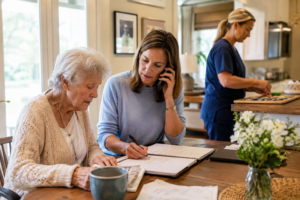
Memory care family communication about a resident's eating habits between her daughter and a consistent caregiver.

The First 72 Hours: What Really Happens After a Loved One Moves Into Memory Care

A daughter recently asked me a question I hear from families all the time: “Even if I know moving Mom is the right decision, what if she gets there and hates it?”

I understand that fear. In fact, I think the anticipation of a move into dementia care is often harder on the family than the transition ultimately is on the resident.

Families picture Mom sitting alone in an unfamiliar bedroom, thinking about everything she has lost. They imagine her asking to go home over and over. They picture days—or weeks—of homesickness, confusion, and distress.

And yes, the first 72 hours after a move into memory care can be emotional. A new environment is still a new environment. Some residents ask to go home. Some are confused. Some need more reassurance than usual.

But what families imagine beforehand is often very different from what those first days actually look like.

The First 72 Hours in Memory Care Aren’t Spent Sitting Alone

This is probably the biggest thing I wish families understood about the transition.

Your loved one isn’t simply sitting in a bedroom contemplating the fact that she’s homesick.

Life is happening around her.

Someone is making breakfast in the kitchen. A caregiver is asking how she takes her coffee. Another resident is sitting nearby. Someone suggests going outside because the weather is beautiful. A family member visiting another resident stops to say hello.

Maybe the musician comes that afternoon and asks for her favorite song. Maybe everyone is baking cookies. Maybe the therapy animals visit. Maybe she spends part of the afternoon on the porch because you’ve already told us that being outside has always made her happy.

The environment may be unfamiliar, but she is not spending every waking moment analyzing the move. She is also eating, talking, listening, walking, resting, laughing, watching what is happening around her, and beginning to participate in a new rhythm of daily life.

She’s busy living.

How We Prepare Before Someone Arrives

A successful dementia care transition starts before move-in day.

At The Sanctuary, we want to learn as much as we reasonably can about a new resident before she arrives—not just her diagnosis or medication list, but who she is.

We want to know:

·        What does she like to eat, and what snacks does she reach for?

·        How does she take her coffee or tea?

·        Does she prefer mornings outside or a quiet chair by a window?

·        What music does she love?

·        Does she enjoy puzzles, baking, gardening, animals, cards, or television?

·        What did she do for a living?

·        What routines have structured her days for years?

·        What tends to reassure her when she is anxious?

·        What little things reliably make her smile?

Those details matter because we can’t make a new home instantly familiar. But we can surround the unfamiliar with things that already are.

Her favorite drink can be waiting. Her preferred snacks can be in the kitchen. Her familiar blanket can be on the bed. If she loves being outside, we can build that into her first day. If she has listened to the same radio program for years, we can put it on.

The setting is new. The pleasures and rhythms of her day don’t have to be.

Why We Give New Residents Extra Attention

The first days are not the time to expect someone to simply figure out a new environment on her own.

When a resident first moves into one of our care homes, members of our management and clinical team intentionally spend extra time there. Our Activity Director, Director of Operations, nurses, and caregivers are getting to know the person, observing what makes her comfortable, and helping establish the beginnings of a routine.

There is a lot of attention. A lot of reassurance. And, frankly, a lot of doting.

That doesn’t mean hovering over someone or forcing constant activity. Some people need quiet. Others immediately want to be where everything is happening. Good dementia care means reading the person in front of you.

The goal is to make sure that when the surroundings feel unfamiliar, the person doesn’t also feel alone.

Sometimes the New Environment Is More Engaging Than the Old One

There is another part of the transition that families don’t always anticipate.

Many people arrive in memory care after their world has gradually become very small.

Some have been living at home, where even with devoted family members or private caregivers, there may be long stretches of the day with very little happening. Others come from larger communities where they have increasingly spent most of their time alone in their rooms.

Then they move into a residential setting where daily life is happening within a few steps of them.

Breakfast is being made. People are talking at the kitchen table. A caregiver asks whether they want to come outside. Someone puts music on. Another resident’s daughter visits and becomes a familiar face. An activity starts without requiring a long walk down a hallway or a decision to leave the room.

For a person with dementia, that can be surprisingly engaging.

Families may be at home imagining Mom thinking constantly about everything that has changed. Meanwhile, Mom may be sitting at the kitchen counter eating a favorite snack while talking with a caregiver who is learning about her grandchildren.

What Does “I Want to Go Home” Mean in Dementia?

This is often the hardest part for families.

Mom says, “I want to go home.”

If you or I said those words, the meaning would probably be straightforward: I know exactly where I live, I understand where I am now, I’ve compared the two places, and I would like you to take me back to my house.

With dementia, the words can carry a much broader meaning.

“I want to go home” can sometimes mean:

·        I’m confused.

·        I want something familiar.

·        I’m tired.

·        I feel unsettled.

·        I don’t know what I’m supposed to be doing.

·        I want to feel safe.

·        I want things to feel the way they used to.

Sometimes the “home” a person is describing isn’t even the home she recently left. It may be a childhood home or a house she lived in decades ago.

That doesn’t mean we dismiss the words. We take the feeling seriously. But rather than arguing—“This is your home now”—we try to understand what the person is asking for underneath the words.

Does she need reassurance? Food? Rest? Familiar music? A walk outside? Someone to sit beside her? A call or visit from family?

Often the most useful question isn’t “How do we convince her this is home?” It’s “What would help her feel safe right now?”

Then the Unfamiliar Starts Becoming Familiar

This is the part that is almost impossible for families to picture before the move.

The caregiver who helped Mom get dressed yesterday is there again today.

And tomorrow.

Someone learns that she likes two sugars in her coffee. Someone remembers that she wants to sit outside after breakfast. Someone discovers which song gets her singing. She begins recognizing a favorite chair. The sounds and smells of the house become predictable.

A routine starts to form.

For people living with dementia, that repetition and familiarity can be powerful. The new environment doesn’t become familiar because someone explains it perfectly. It becomes familiar through experience.

The same faces. The same kitchen. The same morning routine. The same porch. The same caregiver helping at bedtime.

Day by day, the unfamiliar becomes less unfamiliar.

Don’t Judge the Entire Move by the Hardest Moment

If Mom has a difficult first evening, that doesn’t necessarily mean the move was a mistake.

If she asks to go home on day two, that doesn’t tell you what day 14 will look like.

Transitions deserve attention, compassion, and patience. Families should absolutely stay in close communication with the care team and pay attention if distress is severe or persistent.

But I also encourage families not to use one emotional moment during an enormous life change as the final verdict on whether someone can eventually be comfortable there.

We often expect someone with dementia to give us immediate reassurance that we’ve made the right decision. Unfortunately, she may not be able to give us that.

Sometimes the evidence comes more quietly.

She’s sleeping well. She’s eating. She’s sitting with everyone at breakfast. She’s smiling when a familiar caregiver walks into the room. She’s singing with the musician. She isn’t asking to go home as often.

Those small changes are often how a new normal begins.

How Families Can Make the First 72 Hours Easier

You can’t eliminate every difficult feeling from a move, but you can help the care team make the new environment feel more recognizable.

·        Share detailed routines, preferences, interests, and personal history before move-in.

·        Bring familiar belongings, photographs, bedding, or other comforting objects.

·        Tell caregivers exactly how your loved one takes her coffee, what she likes to snack on, and what usually calms her.

·        Share favorite music, television programs, hobbies, and meaningful pastimes.

·        Let the care team know what tends to trigger anxiety or agitation.

·        Expect some adjustment rather than requiring the first day to prove the decision was right.

·        Stay in communication with the care team so you can understand the whole day—not only an emotional phone call or difficult moment.

One Thing I’d Tell My Own Family

If I ever develop dementia and you have to move me somewhere new, I hope you understand that I may not make it easy for you.

I may be confused.

I may ask to leave.

I may even be angry.

But I hope you won’t judge the entire decision by my hardest moment during my first few days.

Give me time to build a new normal.

Tell the people caring for me who I am. Tell them what I love. Tell them my routines. Tell them the little things that make me happy. Make sure somebody knows how I take my coffee.

And then let me begin accumulating something dementia makes especially valuable: familiarity.

The goal isn’t for me to walk through the door on day one and announce that I’m delighted with my new home.

The goal is that, little by little, the faces become recognizable. The routines become predictable. The house begins to make sense.

And eventually, a place that once felt unfamiliar can begin to feel safe.

For many families, that transition happens more peacefully—and often more quickly—than they feared.

Key Takeaways

·        The anticipation of a dementia care transition is often harder for families than the resident’s eventual adjustment.

·        The first 72 hours should focus on reassurance, familiarity, engagement, and learning the resident’s individual rhythms.

·        A new resident isn’t simply sitting alone thinking about the move; daily life, relationships, activities, meals, and routines begin immediately.

·        “I want to go home” can express many needs in dementia and does not always mean a person has evaluated the new environment and rejected it.

·        Don’t judge the long-term success of a move by one difficult moment in the first few days.

·        Familiar caregivers and predictable routines help an unfamiliar environment gradually become recognizable and safe.

Frequently Asked Questions

How long does it take someone with dementia to adjust to memory care?

There is no universal timeline. Some people settle surprisingly quickly, while others need more time. Personality, stage of dementia, previous living situation, routines, health, and the environment all affect adjustment. Look for gradual signs of comfort and familiarity rather than expecting a specific number of days.

Is it normal for someone with dementia to ask to go home after moving?

Yes. “I want to go home” is common and can reflect confusion, fatigue, a desire for familiarity, or a need for reassurance. The care team should consider the emotion or unmet need behind the words rather than simply correcting the person.

What should families bring when a loved one moves into memory care?

Familiar photographs, a favorite blanket or chair when appropriate, meaningful decorations, preferred toiletries, favorite snacks, and other recognizable items can help. Just as important is sharing detailed information about routines, interests, preferences, and personal history.

Should I expect my loved one to be upset during the first few days?

Some confusion or distress can occur, but not every resident has a difficult transition. A thoughtful move-in plan, familiar routines, personalized engagement, and consistent caregivers can make the adjustment gentler.

How do I know whether the move is going well?

Look beyond whether your loved one ever asks to go home. Eating, sleeping, participating in daily life, accepting care, developing relationships with caregivers, and appearing increasingly comfortable with routines are all meaningful signs of adjustment.

You May Also Find These Helpful

Helping New Residents with Dementia Adjust to Their New Home

The transition doesn’t end on move-in day. Learn practical ways families and caregivers can help a loved one develop familiarity, routine, and a sense of safety in a new environment.

What If Mom Doesn’t Want to Move—but You Know It’s the Right Thing?

Sometimes honoring a loved one’s voice and taking responsibility for her safety are both acts of love. This article explores what to do when dementia makes those priorities difficult to reconcile.

More People Doesn’t Always Mean More Connection

A larger community doesn’t automatically create more meaningful socialization. Learn why everyday relationships and familiar caregivers may matter more than the number of people in the room.

Have Questions About an Upcoming Move?

If you’re considering dementia care and worried about how your loved one will handle the transition, we’re happy to talk through what move-in can realistically look like and how we help new residents begin building familiarity from the moment they arrive.

Dementia care transition with a new resident baking with a caregiver while daily activities happen around her.

The Caregiver Equation: Enough People + the Right People + the Same People

Caregiver staffing in memory care is one of the most important things families can evaluate – but I don’t think a staffing ratio by itself tells the whole story.

I talk to a lot of families who are unhappy with the care their parent is receiving somewhere else. Interestingly, they rarely tell me, “Every caregiver there is terrible.”

Usually, they tell me the opposite.

“There is one caregiver Dad absolutely loves. She’s the only person who can get him to shower.”

“There is one woman who actually sits with Mom and makes sure she eats.”

“We adore the caregiver who works on Tuesdays. She really knows him.”

Those caregivers may be wonderful at what they do.

The problem is that one wonderful caregiver cannot be everywhere.

Over the years, I’ve come to believe that great dementia care depends on three things:

·        Quantity. Are there enough caregivers?

·        Quality. Are they good at what they do?

·        Consistency. Does your parent actually know them?

Miss any one of those three, and the experience of care can change dramatically.

Caregiver Staffing in Memory Care Starts With Quantity

Staffing ratios can sound like dry operational numbers until you picture what they mean during an ordinary morning.

Imagine one caregiver is responsible for eight residents. One person needs 20 minutes of encouragement and hands-on help to take a shower. Another needs the bathroom. Someone else has not touched breakfast unless a caregiver sits beside her and cues her to eat. A fourth resident becomes anxious and begins walking toward the front door.

The caregiver may know exactly what each person needs. She may be patient, skilled, and deeply compassionate.

But there are still only 60 minutes in an hour.

Dementia care is extraordinarily time-dependent. Often the difference between completing a task and truly caring for someone is the extra five, ten, or fifteen minutes required to meet that person where she is.

It isn’t enough to put a plate down. Someone may need to notice that Mom hasn’t eaten and sit with her long enough to get her started.

It isn’t enough to announce that it’s shower time. Dad may need a familiar person to joke with him, give him time, and approach the task in the way that works for him. He may initially resist showering, in which case the caregiver needs time in her schedule to ask again in 30 minutes.

It isn’t enough to redirect someone once. A resident who is anxious may need calm redirection again and again.

The question isn’t simply whether a caregiver knows what to do. It’s whether she has enough time to do it.

Quantity Without Quality Isn’t Enough

Of course, simply putting more people on a schedule doesn’t guarantee excellent care.

Dementia caregiving requires judgment, patience, observation, communication, and an understanding that behavior is often communication.

A skilled caregiver notices things that are easy to miss:

·        Mom isn’t eating, even though her plate was served.

·        Dad is resisting a shower because the approach is making him anxious.

·        A resident who is usually talkative has become unusually quiet.

·        Someone is pacing because she may need the bathroom, be in pain, or be looking for something familiar.

·        A small change in behavior may be a sign that something physical or emotional has changed.

Good dementia care is rarely about forcing a task to completion. It is about understanding the person well enough to figure out why the task has become difficult in the first place.

That requires good caregivers.

But even quantity plus quality leaves out the third part of the equation.

Consistency: Does Your Parent Know the Person Caring for Them?

For people living with dementia, familiarity is not a small luxury. It can fundamentally change the caregiving interaction.

Imagine waking up confused about where you are. A person you’ve never seen before walks into your bedroom and tells you it’s time for a shower. Then that stranger begins helping you undress.

From the caregiver’s perspective, she is providing necessary personal care.

From the resident’s perspective, a stranger may be entering her private space and touching her during an incredibly intimate moment.

Suddenly, what gets described as “resistance” or “combative behavior” can make a lot more sense.

Now imagine the same interaction with a caregiver the resident sees every day.

She recognizes the caregiver’s face and voice. The caregiver knows not to rush her. She knows which towel she likes, how she prefers the water, and that she’ll usually agree to shower after breakfast but almost never before it.

That knowledge doesn’t come from a staffing spreadsheet.

It comes from relationship.

Why Temporary Staffing Can Be Hard in Dementia Care

This is one reason I pay so much attention to staffing consistency.

Temporary and agency caregivers can be competent, compassionate people. The problem is not that an agency caregiver doesn’t care. The problem is that she may be walking into a home and caring for people she simply doesn’t know yet.

And in dementia care, familiarity is information.

I’ve spoken with many families who describe serious concerns about medications or personal care when temporary staff unfamiliar with their loved one were covering a community. Whatever the specific cause in an individual situation, those stories reinforce something I’ve seen repeatedly: knowing the resident matters.

A consistent caregiver knows what “normal” looks like.

·        She knows that Dad usually takes his medication easily, so an unexpected refusal gets her attention.

·        She knows Mom normally finishes breakfast, so a full plate means something has changed.

·        She knows a resident’s usual walking pattern and notices when she suddenly seems unsteady.

·        She knows which approach calms someone and which approach tends to make anxiety worse.

Knowing the resident isn’t separate from providing good dementia care. Knowing the resident is part of the care.

How We Think About This at The Sanctuary

Our model was designed around all three parts of the caregiver equation.

During most waking hours, our homes generally operate at approximately one caregiver for every three residents. Overnight, when residents are mostly sleeping, the ratio is approximately one to six.

But I would never tell a family that the ratio alone is the reason the model works.

We also do not use staffing agencies. Our goal is for residents to be cared for by a consistent team of caregivers who have the opportunity to know them over time.

That continuity changes what care can look like.

A caregiver isn’t merely reading that a resident likes coffee. She knows how he takes it.

She isn’t just seeing a note that someone needs encouragement with meals. She knows which foods usually get her started and whether conversation helps.

She knows who needs a slower approach in the morning, who wants to sit outside after lunch, and who will happily take a shower if you make her laugh first.

Those details accumulate.

And over months – sometimes years – the relationship becomes much deeper than a list of preferences on a care plan.

The Relationship Becomes Part of the Care

There is another reason consistency matters that is harder to quantify.

People with dementia still need relationships.

They need people who recognize them, notice them, talk with them, and understand the pieces of their story that they may no longer be able to reliably tell themselves.

I’ve seen caregivers become incredibly close to the residents they care for.

When one of our residents passes away, caregivers will sometimes attend the funeral.

Nobody asks them to go. They are not being paid to be there.

They go because someone they cared for every day has died.

They knew that person’s children. They knew what made her laugh. They knew what frightened her. They knew how she liked breakfast and what kind of day she was having before anyone had to tell them.

That’s what consistency can eventually become.

It starts as a staffing decision.

It becomes familiarity.

Familiarity becomes trust.

And sometimes, after enough time, that relationship starts to feel a lot like family.

What Families Should Ask About Caregiver Staffing

When you’re touring a dementia care community, I wouldn’t stop at, “What’s your caregiver-to-resident ratio?” It’s an important question, but it should be the beginning of the conversation.

I would also ask:

·        How many caregivers are typically working during waking hours and overnight?

·        Does the quoted ratio include nurses, managers, or other employees who are not actually providing hands-on care?

·        Do you use agency or temporary staffing? If so, how often?

·        How long have the caregivers working in this home or unit been here?

·        Will my parent generally see the same caregivers from day to day?

·        What happens when someone calls out?

·        How do caregivers learn a new resident’s routines, preferences, and triggers?

·        If my parent needs extra time to eat, shower, or calm down, is there enough staffing for someone to give them that time?

Listen to the answers, but also watch the room.

Do caregivers seem rushed? Do they know residents by name? Do interactions feel familiar? Does someone notice when a resident needs help without being asked?

The best staffing model isn’t just visible on paper. You can often feel it in the way people interact.

One Thing I’d Tell My Own Family

If I ever need dementia care, don’t just ask how many caregivers are working.

Ask who they are.

Ask how long they’ve been there.

Ask whether the person helping me shower tomorrow is likely to be someone I’ve seen before.

Ask whether she has enough time to notice that I didn’t eat breakfast instead of simply clearing my plate.

Ask whether the people caring for me know what makes me anxious, what makes me laugh, and what a normal day looks like for me.

Because I don’t just want someone assigned to care for me.

I want to be cared for by people who know me.

Key Takeaways

·        Great dementia care depends on quantity, quality, and consistency – not staffing ratios alone.

·        Enough caregivers matter because dementia care often requires time, patience, cueing, redirection, and one-on-one attention.

·        Caregiver skill matters because behavior often communicates an unmet need that has to be understood, not simply managed.

·        Consistent caregivers build familiarity and trust, which can make intimate care and difficult moments less frightening.

·        Temporary caregivers may be excellent professionals, but they cannot immediately know a resident’s routines, baseline, preferences, and subtle changes.

·        When touring, ask not only how many caregivers are present, but who they are, whether they stay, and whether they have enough time to truly know residents.

Frequently Asked Questions

What is a good caregiver-to-resident ratio in memory care?

There is no single ratio that guarantees excellent care, and staffing needs can vary by residents’ acuity, time of day, and the way a community operates. A lower ratio can create more opportunity for individualized attention, but families should also evaluate caregiver skill, turnover, consistency, and who is actually included in the stated ratio.

Why does caregiver consistency matter for people with dementia?

Familiar caregivers can reduce uncertainty and build trust. They also learn a resident’s routines, preferences, behaviors, and normal baseline, which can help them recognize subtle changes and approach personal care in ways that feel less frightening or intrusive.

Are agency caregivers bad for dementia care?

Not necessarily. Agency caregivers can be skilled and compassionate. The challenge is that temporary staff may not yet know the individual resident. In dementia care, that familiarity can be especially important for communication, personal care, behavior support, and noticing changes.

What should I ask about staffing when touring memory care?

Ask about staffing during waking hours and overnight, whether the ratio includes non-caregiving staff, use of temporary agencies, caregiver turnover, how call-outs are covered, and whether residents generally see the same caregivers from day to day.

Why isn’t the staffing ratio enough to judge a memory care community?

A ratio tells you how many people are present, but not whether they are experienced, whether they know the residents, or whether they are consistently assigned to the same people. Strong dementia care requires enough people, the right people, and familiar people.

You May Also Find These Helpful

How We Approach Challenging Behaviors

What looks like a difficult behavior often makes more sense when we understand what a person with dementia is trying to communicate. Read this for a practical look at why patience, familiarity, and individualized approaches matter.

Helping Residents with Dementia Adjust to Their New Home

A new environment becomes easier when the people in it become familiar. This article explains how routines, personal preferences, and consistent relationships can help a new resident begin to feel safe.

Why a Small Boutique Memory Care Facility Is Better for People with Dementia

The size of a care setting shapes far more than the floor plan. Read this to understand how a smaller residential model can influence familiarity, daily rhythms, and individualized dementia care.

Have Questions About Caregiver Staffing?

If you’re comparing dementia care options and want to understand how staffing works in our homes, contact The Sanctuary. We’re happy to explain exactly how our model works and what families should consider when comparing care.


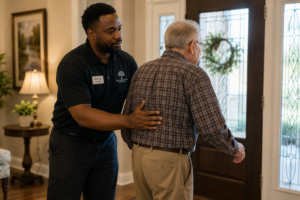
Consistent caregiver helping a woman with dementia get ready while the two share a familiar, trusting interaction.