Preventing Falls in Memory Care: How We Keep Our Residents Safe
By The Sanctuary
Posted February 7, 2025
One of the most frightening phone calls a family can receive is: “Your mom fell.”
And when someone has dementia, preventing falls in memory care is more complicated than adding a grab bar or telling someone to use a walker.
A person may forget that she needs help standing. She may no longer remember to press a call button. She may wake at 2:00 a.m. confused about where she is. She may be physically capable of walking but no longer have the judgment to recognize a hazard. Or she may insist she can do something she has done independently for 80 years even though her body has changed.
That is why I think about fall prevention less as a piece of equipment and more as a system.
The environment matters. Staffing matters. Knowing the resident matters. Medical changes matter. And perhaps most importantly, someone has to be close enough to notice what is happening before the fall occurs.
Falls can never be eliminated entirely. Any community that cares for older adults and promises otherwise is making a promise I don’t think anyone can responsibly make. But there is a great deal we can do to reduce risk while still allowing someone to move, participate and live like a person rather than treating her as a fall waiting to happen.
Why Dementia Makes Fall Prevention Different
Falls are a major risk for older adults generally. The CDC reports that more than one in four adults age 65 and older reports falling each year, and falls are the leading cause of injury-related death in this age group.
Dementia adds another layer because cognitive changes can interfere with the very strategies we normally use to keep someone safe.
A person without dementia may remember: “The physical therapist told me not to stand without my walker.” A person with dementia may agree with that instruction at breakfast and have no memory of it 20 minutes later.
That distinction matters.
· forgetting to use a walker or other mobility aid
· misjudging distance, depth or changes in flooring
· standing impulsively without waiting for assistance
· becoming disoriented at night
· having difficulty following multi-step safety instructions
· wandering or pacing when tired
· being unable to explain dizziness, weakness, pain or another new symptom
So preventing falls in memory care cannot depend primarily on the resident remembering the rules. The care system has to compensate for what dementia has made harder.
Preventing Falls in Memory Care Starts With Someone Being Close Enough to Notice
This is the piece families don’t always think about when touring a community.
Imagine Mary is sitting in a living room and begins leaning forward in her chair. A caregiver who knows her recognizes the pattern immediately: Mary is about to stand, and today she has been unsteady.
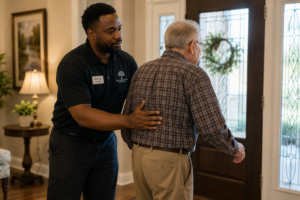
If that caregiver is sitting nearby, she can walk over and offer an arm before Mary is fully upright.
If the caregiver is down a long hallway helping one of many other residents, the exact same situation can end very differently.
That is why caregiver ratios matter so much to fall prevention.
At The Sanctuary, our six-resident homes generally have two caregivers during most waking hours – a 1:3 caregiver-to-resident ratio – and one caregiver overnight while residents are primarily sleeping. The point isn’t that two people can physically prevent every fall. They cannot.
The point is that a smaller number of residents gives caregivers a much better chance of noticing the moments that come before a fall: someone getting restless, standing repeatedly, forgetting the walker, becoming weaker than usual, or trying to transfer without help.
Fall prevention is often about what happens 10 seconds before the fall.
The Environment Should Do Some of the Work
Good dementia care should not require residents to successfully navigate an obstacle course.
The physical environment can either reduce risk or create more opportunities for something to go wrong. This is particularly important when someone has changes in vision, depth perception, judgment or spatial awareness.
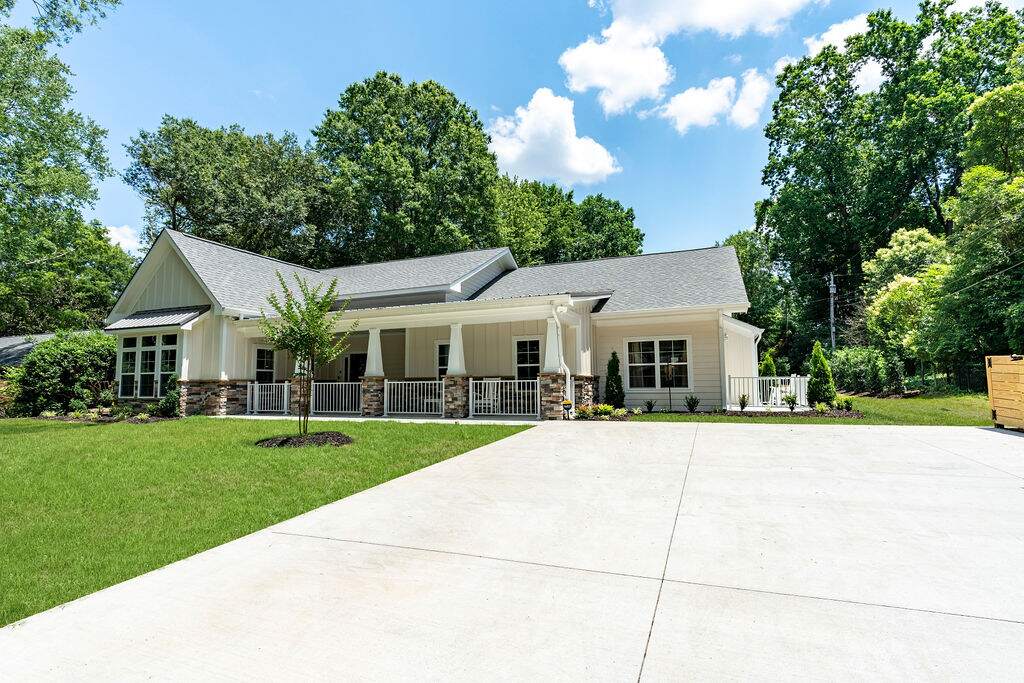
In our Charlotte homes, we intentionally favor a simple residential layout that is easy to understand and navigate. Safety features include:
· flat flooring without unnecessary level changes
· zero-entry showers that eliminate a step over a tub or shower ledge
· grab bars and supports where residents need them
· clear walking paths without loose rugs and unnecessary clutter
· good lighting, particularly in areas residents use at night
· common spaces where caregivers can naturally see and interact with residents
The National Institute on Aging similarly recommends reducing trip hazards, improving lighting and adding bathroom supports as part of fall prevention for older adults.
None of those changes is dramatic. That’s partly the point. The safest environment is often one that quietly removes opportunities for mistakes without constantly reminding a person that she is being supervised.
The Best Fall-Prevention Plan Is Individual
Two residents can both be labeled “fall risks” and need completely different interventions.
Richard may be strongest in the morning but become tired and unsteady late in the afternoon. Mary may walk beautifully once she is standing but forget that she needs help getting out of her chair. Someone else may become dizzy after a medication change. Another resident may wake frequently at night and try to find the bathroom.
A generic fall-risk label doesn’t tell us enough.
We want to know:
· When is this person most likely to fall?
· What was happening immediately before previous falls?
· Does the resident forget a mobility aid?
· Is transferring the greatest risk, or walking?
· Are falls happening at night?
· Has strength, balance or gait changed?
· Is the resident rushing to the bathroom?
· Could pain, illness, dehydration, vision changes or medication effects be contributing?
· What kind of cueing or assistance actually works?
The CDC recommends a multifactorial approach to fall risk that can include clinical evaluation, medication review, strength and balance work and environmental changes. In dementia care, those clinical pieces need to be combined with close day-to-day observation because the resident may not reliably recognize or report the change herself.
Technology Can Help – But It Does Not Replace Caregivers
For residents at particularly high risk, monitoring tools can be useful.
Depending on an individual’s needs, we may use bed, chair or floor alert systems that notify caregivers when a high-risk resident begins moving or attempting to stand. The purpose is not to restrict movement. It is to give the caregiver an opportunity to get there quickly and assist.
But I think this distinction is important: an alarm doesn’t prevent a fall.
A person prevents a fall.
The technology simply tells that person where she is needed.
If the alert goes off and the caregiver is responsible for too many other people, the equipment has limited value. Technology works best when it supports an attentive care model rather than substitutes for one.
Sometimes a New Fall Is Telling You Something
When someone who has been relatively steady suddenly starts falling, I don’t like to assume, “Well, her dementia is getting worse.”
Maybe it is. But a change deserves curiosity.
Is she weaker? Is she sick? Is she dehydrated? Is she dizzy when she stands? Has a medication been added or changed? Is she in pain? Has her vision changed? Is she sleeping poorly? Has her gait changed?
Sometimes the fall is the first visible sign that something else is different.
This is one reason communication among caregivers, nurses, families and medical providers matters. The caregiver who says, “Richard isn’t walking the way he normally does today,” may be providing an extremely important piece of information.
Preventing falls in memory care requires noticing patterns, not simply documenting incidents.
What Happens After a Fall Matters Too
Even with excellent care, falls sometimes happen.
When they do, the response shouldn’t end with checking for an injury and completing an incident report.
We also need to ask: What can we learn from this?
Was the resident trying to reach the bathroom? Did she stand without her walker? Was this an unusual time of day? Was she more confused than normal? Did something change medically? Was there a preventable environmental factor?
Depending on the circumstances, a resident may need medical evaluation, and families should be informed appropriately. But once the immediate situation is addressed, the care plan should also be reconsidered.
The goal isn’t blame. It is to reduce the chance that the same set of circumstances produces the same outcome again.
Safety Shouldn’t Mean Keeping Someone in a Chair All Day
There is another side to this conversation that I think is just as important.
The safest possible resident, in a purely theoretical sense, might be one who never stands up.
But that is not a life.
Mobility, strength, socialization, independence and dignity matter too. Physical activity can help older adults maintain strength and balance, and unnecessarily limiting movement can create its own problems.
So good fall prevention isn’t about eliminating movement. It is about making movement as safe as reasonably possible.
That may mean walking beside someone. Cueing her to use her walker. Choosing an appropriate chair. Keeping pathways clear. Working with therapy when appropriate. Providing the right level of assistance with transfers. Or simply having enough people around that someone doesn’t have to choose between staying seated indefinitely and getting up alone.
To me, the goal is not zero freedom in exchange for zero risk.
The goal is the best balance we can create between safety and living.
How We Think About Fall Prevention at The Sanctuary
When a resident is at risk for falls, we don’t think there is one magic intervention.
We think in layers:
· Know the resident’s individual pattern and history.
· Keep the physical environment simple, visible and easy to navigate.
· Maintain enough caregiver presence to notice risky moments early.
· Use consistent caregivers who recognize changes in the resident.
· Use monitoring tools selectively when they add meaningful protection.
· Communicate changes among caregivers, nurses, family and clinical providers.
· Reassess after a fall instead of assuming it was inevitable.
· Preserve mobility and dignity while reducing unnecessary risk.
That layered approach is what preventing falls in memory care really means to me.
It isn’t a grab bar.
It isn’t an alarm.
It isn’t a policy binder.
It’s dozens of small decisions throughout the day made by people who know the resident well enough – and have enough time – to notice.
What Families Should Ask About Falls When Touring Memory Care
If falls are already a concern for your loved one, I would ask very specific questions during a tour:
· What is the hands-on caregiver-to-resident ratio during waking hours and overnight?
· How do caregivers know which residents need assistance standing or walking?
· What happens when a resident repeatedly forgets to use a walker?
· How are nighttime fall risks handled?
· What environmental features reduce tripping and transfer risks?
· Do you use bed, chair or floor alerts for selected residents?
· What happens after a fall?
· Who communicates with the family?
· How does the team decide whether a new fall could reflect a medical or medication-related change?
· How do you balance fall prevention with maintaining mobility?
The answers will tell you much more than simply asking, “Do you have a fall-prevention program?”
Key Takeaways
· Preventing falls in memory care requires more than equipment because dementia can affect judgment, memory, perception and the ability to follow safety instructions.
· Caregiver presence matters: many falls can only be interrupted if someone notices the risky moment early enough to help.
· A simple, dementia-friendly environment can reduce unnecessary hazards and confusion.
· Fall-prevention plans should be individualized around the resident’s patterns, mobility, medical risks and routines.
· Bed, chair and floor alerts can support care for selected residents, but technology does not replace adequate staffing.
· A sudden increase in falls may warrant evaluation for medical, medication, balance or other changes.
· After a fall, the team should look for patterns and update the care approach rather than treating the event as inevitable.
· Good fall prevention balances safety with mobility, dignity and quality of life.
Frequently Asked Questions
Why are people with dementia at higher risk for falls?
Dementia can affect judgment, memory, visual-spatial processing and the ability to follow safety instructions. A person may forget a walker, stand without assistance or become disoriented, while age-related changes in strength, balance, vision and medications can add further risk.
Can falls be completely prevented in memory care?
No responsible care setting can guarantee that an older adult will never fall. The goal is to identify individual risks, reduce preventable hazards, provide appropriate supervision and assistance, and respond to changes quickly.
How can memory care help prevent falls?
Effective fall prevention in memory care can combine caregiver supervision, an easy-to-navigate environment, individualized care planning, mobility assistance, appropriate monitoring technology, communication with families and clinicians, and reassessment when a resident’s condition changes.
Do bed and chair alarms prevent falls?
They can alert caregivers that a high-risk resident is beginning to move, which may allow someone to assist quickly. They are a tool, not a substitute for caregivers, and whether they are appropriate depends on the individual resident and care setting.
Should someone who falls frequently stop walking?
Not automatically. Mobility has important benefits, and excessive restriction can reduce strength and independence. A qualified clinical team should help determine the safest level of activity, assistance, therapy and mobility support for the individual.
What should families ask after a parent falls in memory care?
Ask what happened immediately before the fall, whether anything was different that day, whether injury or medical evaluation was needed, whether medications or illness could be contributing, and what changes will be made to the care plan to reduce similar risk.
You May Also Find These Helpful
10 Questions to Ask When Touring a Memory Care Facility
A beautiful building tells you very little about what happens in the ten seconds before a resident needs help.
Read this for the questions that reveal staffing, consistency, engagement, communication and the reality of day-to-day care.
How We Approach Challenging Behaviors
A sudden change in behavior – just like a sudden change in falls – can be communication that something else is wrong.
Read this to understand why curiosity about the cause often leads to better dementia care than simply labeling the behavior.
The Reality of Dementia Care: Why Home Care Often Isn’t the Best Option
Home can feel familiar, but familiarity alone doesn’t guarantee adequate supervision, safe design or consistent dementia-specific care.
Read this if you’re weighing whether remaining at home is still the safest and most supportive option.
Have Questions About Your Loved One’s Fall Risk?
If falls are becoming more frequent or you’re trying to understand whether a different care setting may be appropriate, contact The Sanctuary. We’re happy to talk through what you’re seeing and the questions worth asking.
What Should a Memory Care Assessment Really Evaluate?
A memory care assessment should reveal more than physical ability. Learn what families and communities should evaluate before a dementia-care move.
You Can’t Advocate for Someone When You Don’t Know What’s Going On: Communication in Memory Care
Communication in memory care helps families advocate for loved ones with dementia. Learn what families should know, ask, and reasonably expect.
The First 72 Hours: What Really Happens After a Loved One Moves Into Memory Care
The first 72 hours in memory care can worry families. Learn what really happens after move-in and how familiarity, activity and routine help.